




[ HOME ]    [ Stock List ]    [ Stock Modifications ]    [ Salesman ]    [ Manufactured List ]    [Technical Index ]   


The Electric Heater Specialists
HEATERS FOR EVERY APPLICATION

wpe1.jpg (1735 bytes)


Technical: Installation

Cartridge/Superwatt Heaters

The most important thing to remember about the installation of a cartridge heater is that the cartridge should be a close fit in the hole into which it is inserted. This results in fast heat transfer to the surrounding material and aids in keeping the element as cool as possible for long life.

Cartridge units are made with special tubing which is a few thousandths undersize to insure a free fit for easy installation. To install cartridge heaters, drill and ream holes to the proper length and the nominal diameter plus .001" maximum minus .000" of the cartridge heater (3/16", 3/8", 1/2", 5/8", etc.) For example, a 1/2" cartridge heater actually measures .497" diameter. A hole should be drilled and reamed to 1/2" diameter + .001" -.000" to insure proper fit. Always finish-ream drilled or cast holes to insure a smooth, uniform metal to metal contact. A knockout hole (Fig. 1) should be provided if possible to facilitate cartridge removal. The receptacle hole should be free from oil before cartridge heater installation to avoid contamination and short heater life.

Fig. 1
Figure 1

If there is danger of a heater slipping from its hole, it should be held in place with metal clips (Fig. 2).

Fig. 2
Figure 2
Do not use set screws to hold cartridge heaters in place. Lead wires, especially when the heater is used in a moving die or platen, should be supported (Fig. 3) or protected with a lead spring (See SF-5 in Special Features).

Fig. 3
Figure 3

Fig. 4
Figure 4

On many applications plastic material, machine oil, and/or moisture may be present. Cycling of a cartridge heater causes these materials to be absorbed. Heaters, therefore, should be carefully selected for these applications utilizing sealed bottoms, protective conduit for leads and if necessary, hermetic sealing for long heater life. These extras are available from the factory at a nominal additional charge (See Special Features).


Square/Rectangular Heaters

Square and Rectangular Heaters


Strip Heaters

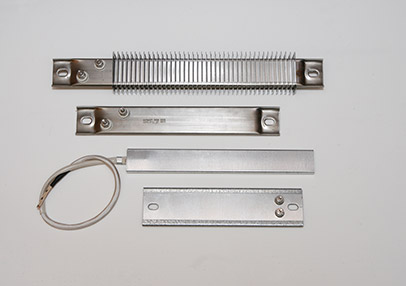
Strip Heaters are designed for contact heating and therefore must be tightly clamped to the object to be heated to keep the heater from expanding away from the surface. Care should be taken to see that the heaters are placed squarely against the surface to be heated. Air gaps between the heated surface and the heater will result in poor heat transfer and shorter heater life.

Mounting
Strip Heaters should be firmly clamped with heavy metal strips. These should be arranged across the heater (or heaters) so that there will be bolts on each side of the heater. These bolts should be spaced approximately 3 to 4 inches apart. (Fig. 1) Use heaters with mounting holes only in air-heating applications, and only when necessary. The reason for this is that as the heater heats up, it expands away from the surface to be heated causing air gaps and poor heat transfer.

Figure 1


Using Mounting Holes
When strip heaters are fastened to the object to be heated utilizing mounting holes or used as an air heater, the screws that are used for mounting should be provided with lock washers and should not be drawn up tightly because the strip heater should be free to expand. Unit lengths beyond 24" may require special mounting to allow for expansion. Consult factory.


Band Heaters

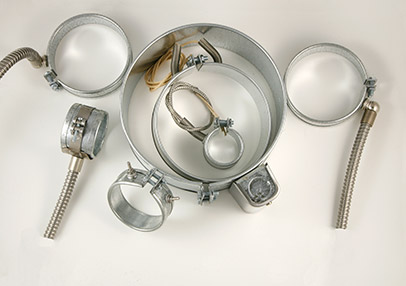
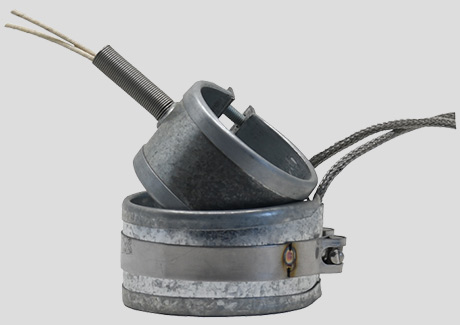
Band heaters should be clamped securely to the object to be heated. They should be mounted so that they are not tilted in assembly, but are placed squarely against the surface to be heated. Air gaps as a result of poor clamping, result in poor heat transfer, excessive heat loss, and short heater life. (Fig. 2)

Band heaters should be clamped securely and squarely to the surface to be heated, run at operating temperature and retighten to correct for the effects of expansion.

Figure 1 - Good

Figure 2 - Poor


Installation in Air Ducts:
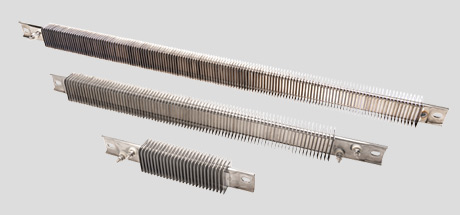
Finned strips and duct heaters

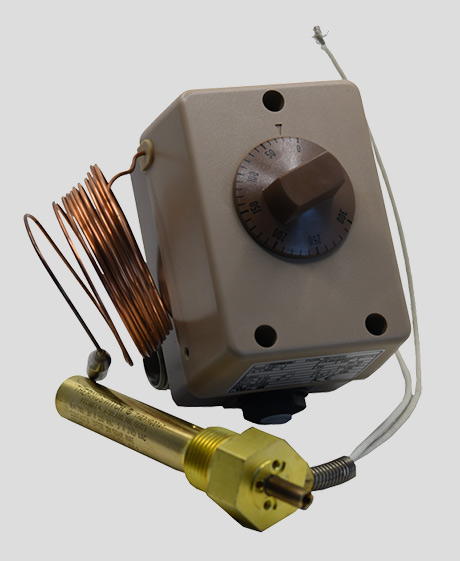
1.  Locate regulating thermostat on downstream side of heater near the top of the duct.
2.  Mount heater with terminals at the duct bottom to prevent overheating.
3.  As a safety feature in the event of abnormal temperatures or safety requirements, it is suggested to use a thermal cutout in conjunction with thermostatic control, or by itself when no thermostat is used.

Installation in Air Ducts

Oven heating (Stainless Steel Strip Heaters):
1.  When mounting strip heaters in an oven, allow for expansion and contraction by loosely bolting one mounting tab and securing the other tab firmly.
2.  Mount the strip with the terminals at the bottom or cooler part of the oven.
3.  In a forced air system, the width of the strip should be parallel to the direction of the air flow.
4.  Mount strips on edge in horizontal installation across the bottom and along the sides of the oven, allowing 3" minimum air space between the heater and the bottom of the oven wall to allow for proper circulation of heated air. For large ovens, allow greater clearance areas.
5.  In horizontal mounting, install a protective screen or grill above the strips at the bottom of the oven.
6.  Support strips on 36" centers to prevent sagging.

[ HOME ]    [ Stock List ]    [ Stock Modifications ]    [ Salesman ]    [ Manufactured List ]    [Technical Index ]   

HH01580A.gif (1311 bytes)

We can be reached by e-mail at sales@hotwatt.com
When ordering catalogs please include your
phone number and mailing address.